

Ringdocus: The Key Players
Part 2 of a preview and behind the scenes of The Ringdocus Project
The full book can be found on Amazon
What is it that everyone concerned with cryptids, no matter their opinions, is after?
Proof! And not just any proof, but solid, physical evidence.
Unlike with most cryptids, we have that holy grail in this case, but it hasn’t gotten us any further ahead in knowing more about this mysterious animal. Hesitation to conduct a DNA test on the mount has left us high and dry in the knowledge department, but DNA isn’t the only way to learn about a strange animal.
Eyewitnesses are the keystones of cryptozoological research, especially when there’s hardly anything else to go on. They describe these elusive creatures and give us points of reference for comparing accounts and building a more consistent profile of the cryptid. The more consistencies that emerge, the more likely it is that such an animal exists, but relying on eyewitness accounts can be a fraught situation; how do we sort out the tall tales from the truth?
The Ringdocus case offers a unique opportunity regarding eyewitness testimony that presents both challenges and advantages. One advantage of interviewing modern witnesses is that we can gauge someone’s truthfulness based on behavior. With everyone involved in the Ringdocus case, we don’t have that directly. These are historical figures who are no longer alive, but this also presents an interesting advantage.
I actually conducted the historical research of this case for a college history class (and boy did I take a ton of those!), and one thing that was emphasized in many of my classes is a specific way of looking at historical documentation, which is what the Hutchins’ witness testimony is.
We looked at the author behind the document, whether we knew who they were or not, and discerned from reading the document what their potential motives were, what role they served, what the purpose of the document is, and used those points to better understand the document itself, the content, and its value as a reputable source with less bias.
The same method can be applied to the Ringdocus witnesses and their testimony, allowing us to better understand the legitimacy of the descriptions of this animal and its preservation; through that, we can better understand the Ringdocus and the circumstances of the case.
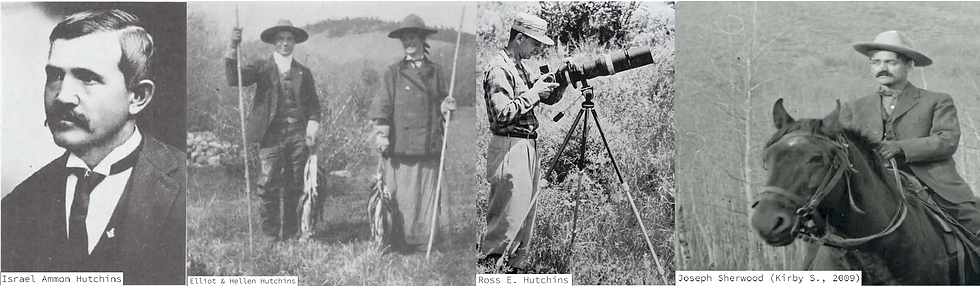
Both Joseph Sherwood and the Hutchins were hard-working, smart, and self-reliant people who relied on the land. The Hutchins children and grandchildren were known to be hardy and intelligent, adapting well to the frontier that Israel brought them to, and their grandson Ross particularly found a fascination with the nature around him, developing a naturalist’s mindset early on.
Sherwood had a reputation and standing in his community, served many important and skilful roles, but was also a businessman. The Hutchins, in the grip of the harsh ’87 winter, were focused only on surviving, evident in how Hutchins traded the body of the creature for a single cow he had lost, so the likelihood of them making up or exaggerating the story of the Ringdocus is not likely, especially considering the no-nonsense character of the family and their son who recorded the incident.
Sherwood would’ve had more motive and the skillset to pull a hoax as a man wanting to attract revenue, but with his reputation and standing in the community, that's unlikely too. Sherwood would’ve had a lot to lose if it were discovered that the Ringdocus was a hoax. It is more likely that Sherwood simply saw an opportunity in the strange animal presented to him.
The way the Ringdocus was described by the Hutchins matches the preserved body, adding legitimacy to Sherwood’s work of preserving the animal in its true form.
Without the account of the Hutchins’ run-in with the Ringdocus, recorded by Israel’s son Elliot, we would know very little about this animal.
In fact, we wouldn’t know anything at all.
No written records of this animal from the other ranchers it allegedly terrorized exist, and eyewitness accounts of it today are few and far between.
The mount would be the only thing we’d have with no story to lead me on my journey.


Comments